
Nightshade Food List : Should You Avoid Them?


Are nightshades overwhelming you? Here’s your complete guide to nightshades featuring a full list, why you may want to avoid them, and substitution recipes!
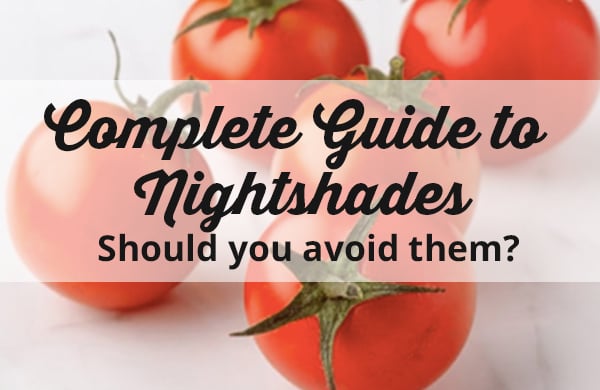
Nightshade vegetables seem like healthy, nutrient-dense additions to any diet. Tomato is known as a cancer fighter, bell peppers are commended for their nutrient density, and eggplant is a common low carb swap. However, not everyone can tolerate nightshade vegetables and many deal with inflammation and aggravation of chronic illness as a result of eating nightshades.
List of Inflammatory Nightshade Vegetables & Fruits
Nightshades belong to the Solanaceae family and include thousands of edible and inedible plants.
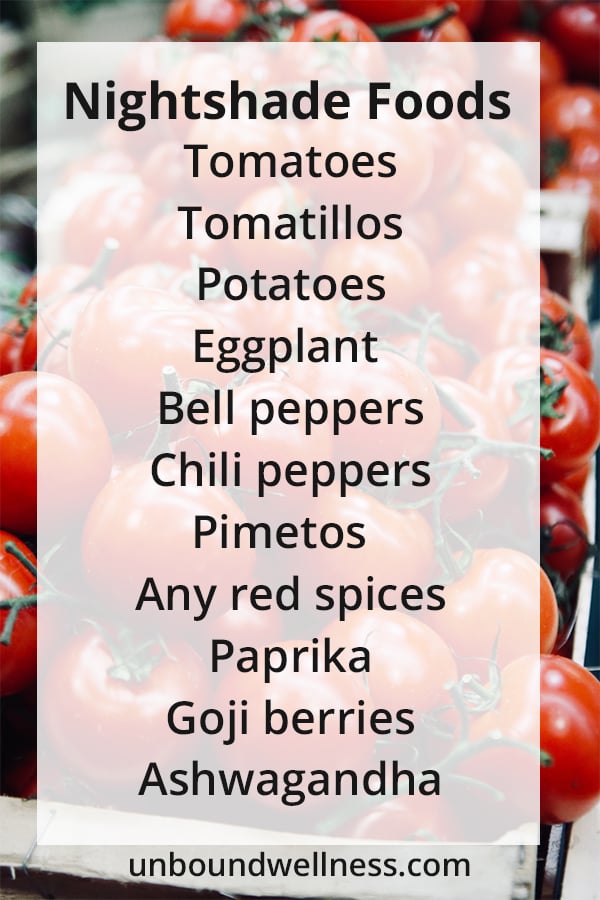
These are the common nightshades…
- Tomatoes (all varieties, and tomato products like marinara, ketchup, etc.)
- Tomatillos
- Potatoes (white and red potatoes. However, sweet potatoes are not nightshades.)
- Eggplant
- All peppers (bell peppers, jalapeno, chili peppers, and hot peppers)
- Red spices (curry powder, chili powder, cayenne powder, red pepper)
- Paprika
- Pimentos
- Tobacco
- Goji berries
- Ground cherries (different from regular cherries)
- Ashwagandha
Common foods that are mistaken for nightshades, but are not…
- Zucchini is not a nightshade
- Sweet potato is not a nightshade
- Mushrooms are not nightshades
- Onions are not nightshades
- Black pepper is not a nightshade
Are nightshades inflammatory? Should you avoid them?
Not necessarily. Nightshade vegetables do have a lot of nutrient density on their own and can be a healthy part of a balanced diet for many. By no means would I ever suggest that the human race as a whole needs to go nightshade-free.
However, nightshades are known to be inflammatory for many and can flare up joint issues, digestive symptoms, and other inflammatory diseases. Those with the following conditions are certain groups of people that may have nightshade issues…
- Rheumatoid arthritis
- Any joint issues
- Digestive issues or “IBS”
- Autoimmune disease (Hashimoto’s, graves, etc.)
Many compounds within nightshade vegetables have been shown to cause inflammation in some cases. For example, potato glycoalkaloids have been shown to impact intestinal permeability and “IBS” issues (source 1), thus, causing digestive distress as well as other related issues. Solanine (which is a glycoalkaloid) and is found in eggplant and potatoes can actually have toxic effects if eaten in excessive amounts (source 2).
Also, saponins which are found in nightshades have been shown to impair digestion and limit nutrient uptake (source 3).
Finally, capsaicin which an alkaloid found in peppers is often known to have anti-inflammatory properties, but it has also been shown to have the opposite effect (source 4).
Thus, not every food will have the same effect on every person, but there is reason to consider nightshade intolerance if certain symptoms and concerns are already an issue.
What are the common symptoms of nightshade intolerance?
Everyone is different and your symptoms will vary. But typically, you can look out for these symptoms…
- Joint pain
- Inflammation
- Fatigue
- Migraines
- Skin flares
- Digestive distress
- Flares to any preexisting conditions
Have one of these conditions but don’t feel like you have nightshade issues? I was in the same boat. I didn’t particularly feel a difference when I ate tomatoes, so why would I avoid them? Not having an obvious reaction to an inflammatory food is common, and doesn’t necessarily mean it’s not inflammatory for you. What can happen is that our body can be so inflamed that we just don’t notice the nuances anymore. That’s why elimination diets like the autoimmune protocol are the gold standard for nailing down food intolerance as they allow your body the chance to anti-inflame so you can actually determine whether or not you have a reaction when you reintroduce the food.
Many nightshade ingredients hide in otherwise healthful foods. Here’s how to spot them…
I’ve grown very accustomed to finding where the heck all of those sneaky nightshades are hiding after having entirely too many
Potato starch hides in…
- Gluten-free bread, pizza crust, crackers, and baked goods
- Some soups or other products with a thickener
Nightshade spices hide in…
- Most Mexican food
- Sausage and hot dogs (these almost always have paprika)
- Breakfast sausages
- Anything spicy… I just automatically assume there’s some nightshade in there
Tomatoes hide in…
- Vegetable broth
- Seasonings (Italian blends and others will often have tomato)
How do you substitute nightshades in recipes?
Does being nightshade-free mean that you have to live without the flavors forever? Absolutely not! There are so many ways to fake it. Here are some of my favorite substitutes for nightshade heavy dishes…
How to make substitutions for tomatoes…
- Substitutes for the marinara sauce. Make yourself homemade Nomato sauce!
- Substitute for chili. I’ve got you covered there with this instant pot nomato chili!
- Substitute for enchiladas. This zucchini chicken enchilada casserole comes with a nightshade-free enchilada sauce, which is not something you see every day at your local Mexican restaurant!
- Nightshade free lasagna Lasagna. This one pot lasagna skillet is grain-free, dairy-free, and nightshade-free! Hallelujah!
How to make substitutions for eggplant…
- Zucchini. Zucchini is a similar texture for eggplant and can be a good swap! These zucchini fries are similar-ish to eggplant parmesan! Try these Zucchini fries.
How to make substitutions for potatoes…
- Sweet Potatoes
- Plantain
- Rutabaga
How to make substitutions for red spices…
- Cumin
- Cumin is a seed spice (so, not AIP) that’s nightshade-free and has a great kick to it. One thing to note is that it’s green! I’ve made chili with cumin before and watched it turn green and was super confused… it’s the cumin!
- Black pepper
- Black pepper is also a seed spice (not AIP) but it’s not nightshade and is always a great swap to add spice.
- Turmeric
- I’m constantly using turmeric to swap for red spices. It adds color, a bit of spice, and tons of flavor! This turmeric chicken curry recipe is one of my favorites and features a nightshade-free curry.
Can nightshades intolerance be healed?
It’s 100% possible. It all depends on how your body heals, and your own bio-individuality. For someone like me, I’m not sure if I’ll ever be able to reintroduce nightshades. I just have such a gnarly reaction to red spices, peppers, and potatoes. However, tomato is the one nightshade that I can be slightly flexible in moderation.
Many people do reintroduce nightshades, but it really just depends. It may not be in the cards for everyone, but there certainly is hope! Following an elimination protocol that allows for healing and slow reintroduction like the autoimmune protocol is an amazing way to tackle this.
Regardless, I hope this list helped you see how much opportunity there is to substitute nightshades, and how to live with the intolerance!
This article was originally published in August 2018 and was updated in December of 2019.
I am going to a NeurocranioRestructuring Doctor who works with a medical median and they recommend that I stop eating nightshades. I was hoping to find some tasty substitution for them and like a miracle, I saw your site. Just what I was looking for substitutions for nightshades. Thanks.
So glad it was helpful!! Thank you!
Great article, I am one of those people who gets really unwell (joint pain & oddly – depression) with nightshades especially with Aubergine/eggplant & bell peppers.
Thank you for the thorough information. I really appreciate all the content and the delish recipes you have. Keep on doing what you’re doing!
Thanks!!
Hi – thanks for your recipes! I have saved the link and will definitely be trying some of them. So many recipes involve cooked tomatoes and capsicum and I just can’t tolerate it – I get a searing pain in the middle of my chest. The Dr simply prescribed Lo-Sec, but it’s more than that. I’ve suffered with inflammatory tendonitis for years (oka Fibromyalgia: though I don’t think that’s an accurate diagnosis tbh). It also explains why I have always avoided pizzas, mince dishes, sausages, soups, and other staple things. Cutting out my beloved potatoes is going to be hard in the extreme though.
But anyway, would you have an answer as to why I can tolerate raw tomatoes and capsicum and not cooked?
From my own research, it can be fairly common to tolerate foods raw and not cooked, and then vice versa. Cooking does change the food a lot so it not uncommon to experience this. Some food sensitivity tests even test both raw/cooked food for this reason.
Thanks for info!
Why does the AIP website say to avoid cumin?
Cumin is a seed spice and is not AIP compliant for the elimination phase.
So glad i found this! Im doing Whole30 to help me figure out my ibs issues and have always had headaches and diarrhea after eating red peppers in particular among other foods that aren’t nightshades. I will eliminate all of these too and see how that helps. Also, you mentione “white” potatoes including red. Does thag also include the purple and types they refer to as “gold” or is it just russet and red potoatoes
Good question! Yes, all potato varieties except for sweet potato are nightshades 🙂
Thanks for all this info. I have eliminated nightshades for over a year now. I woke up today with the same pain in my body that made me eliminate them and found out (after having a new smoothie mix yesterday) that goldenberries/physalis are nightshades. Who’d have known 🙂
I now avoid these but feel there is some other trigger. After seeing this atricle I am now confident that the Red spices and peppers are the most likely cause of my residual problems.
I now avoid these but feel there is some other trigger. After seeing this atricle I am now confident that the Red spices and peppers are the most likely cause of my residual problems.
I am quite sad to think nightshades could be the issue.
I am excited to embrace new cooking styles, still learning…and those hidden ‘trigger’ spices are tricky. Something gives me a ‘hangover’ type headache. Always thought it was wine, now I know different.
I noticed years ago that tomatoes cause me to break out – as in ACNE..I have rosacea and tomatoes make it flare up. I can have cooked tomatoes/sauce every now and then..but fresh is a no-no and if I eat tomato-based foods too often (3+ times/week)..my skin suffers. Thanks for sharing this info!
I too have rosacea and have been on AIP for the better part of a month. Tried eating tomato sauce last night and again today. What a mistake. My face broke out again for the first time in weeks. No more tomatoes for me I guess.
I’m so sorry!! I hope you feel better soon.
For everyone that is reading this – these plants aren’t the issue. If its anything it’s the chemicals pumped into these items and the many other chemicals we are knowingly and unknowingly consuming that is causing all these inflammatory responses.
Eat you own foods and you’ll see how quickly these diseases evaporate.
Good luck to all of you. As someone who suffers from diverticulitis – I’m with you. But I won’t blame plants, rather the amount of poison I’ve ingested eating foods from grocery stores – processed and otherwise.
These are my favorite dishes. At the same time, I am referring to nutrient-rich foods for strong hair
Thank you for this information. I have problems with most of the nightshades. Potatoes don’t seem to be problematic. Eggplant and raw tomatoes will blister the inside of my mouth and make it peel. Bell peppers and cooked tomatoes will give me terrible indigestion, same with lots of spicy foods. Having options for replacement foods is awesome.
First of all thank you so much for this informative article. I was diagnosed a year ago with Hashimotos and have been a bit depressed over the things that have been taken out of my diet and not coming up with things to replace those I love. I have been told I need to be gluten free, grain free, dairy free, lentil free and nightshade free. That doesn’t leave much. Under the list of nightshades my doc included broccoli, cauliflower and mushrooms. I don’t see those in the usual nightshade list. Then someone told me that Cauliflower and broccoli were OK if they were cooked. I made a cauliflower “casserole” with a little bacon in it and baked it well. I won’t do that again as I was awake most of the night with indigestion. Thank you for your suggestions and recipes above that will enable me to make that lasagna and spaghetti again with alternative ingredients. I can’t wait to try them and learn to still eat the things we love but just altering the ingredients.
I would for sure work one on one with a nutritionist on this. Broccoli, cauliflower, and mushrooms aren’t nightshades, but cauliflower and broccoli are high-fodmap. A lot of people who have digestive issues also have fodmap issues, so that may be something to bring up to a nutritionist! Good luck!