
Nightshade Food List : Should You Avoid Them?


Are nightshades overwhelming you? Here’s your complete guide to nightshades featuring a full list, why you may want to avoid them, and substitution recipes!
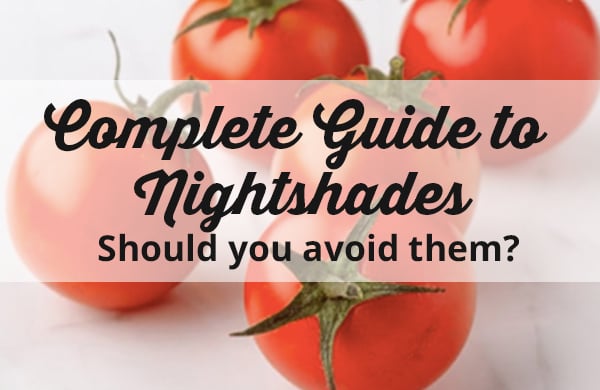
Nightshade vegetables seem like healthy, nutrient-dense additions to any diet. Tomato is known as a cancer fighter, bell peppers are commended for their nutrient density, and eggplant is a common low carb swap. However, not everyone can tolerate nightshade vegetables and many deal with inflammation and aggravation of chronic illness as a result of eating nightshades.
List of Inflammatory Nightshade Vegetables & Fruits
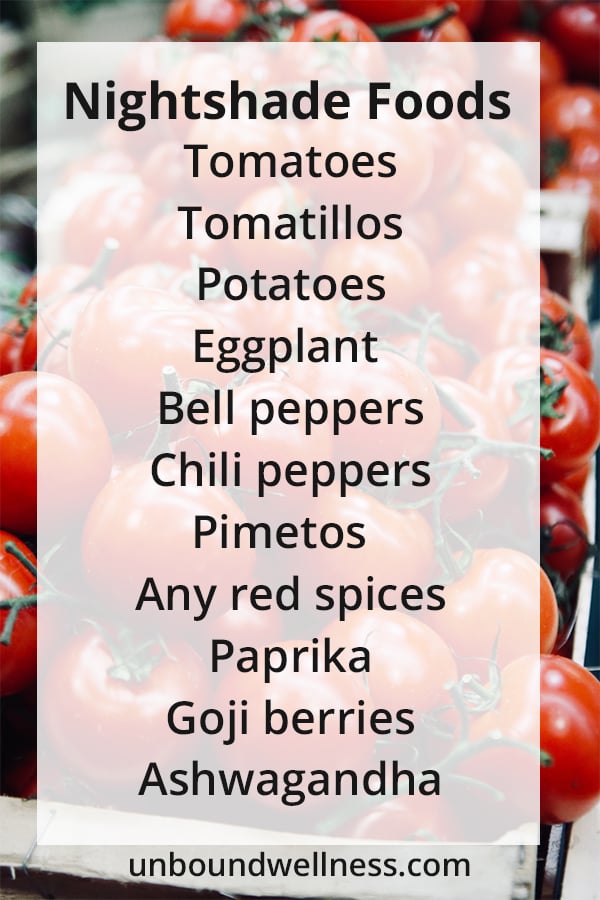
Nightshades belong to the Solanaceae family and include thousands of edible and inedible plants.
These are the common nightshades…
- Tomatoes (all varieties, and tomato products like marinara, ketchup, etc.)
- Tomatillos
- Potatoes (white and red potatoes. However, sweet potatoes are not nightshades.)
- Eggplant
- All peppers (bell peppers, jalapeno, chili peppers, and hot peppers)
- Red spices (curry powder, chili powder, cayenne powder, red pepper)
- Paprika
- Pimentos
- Tobacco
- Goji berries
- Ground cherries (different from regular cherries)
- Ashwagandha
Common foods that are mistaken for nightshades, but are not…
- Zucchini is not a nightshade
- Sweet potato is not a nightshade
- Mushrooms are not nightshades
- Onions are not nightshades
- Black pepper is not a nightshade
Are nightshades inflammatory? Should you avoid them?
Not necessarily. Nightshade vegetables do have a lot of nutrient density on their own and can be a healthy part of a balanced diet for many. By no means would I ever suggest that the human race as a whole needs to go nightshade-free.
However, nightshades are known to be inflammatory for many and can flare up joint issues, digestive symptoms, and other inflammatory diseases. Those with the following conditions are certain groups of people that may have nightshade issues…
- Rheumatoid arthritis
- Any joint issues
- Digestive issues or “IBS”
- Autoimmune disease (Hashimoto’s, graves, etc.)
Many compounds within nightshade vegetables have been shown to cause inflammation in some cases. For example, potato glycoalkaloids have been shown to impact intestinal permeability and “IBS” issues (source 1), thus, causing digestive distress as well as other related issues. Solanine (which is a glycoalkaloid) and is found in eggplant and potatoes can actually have toxic effects if eaten in excessive amounts (source 2).
Also, saponins which are found in nightshades have been shown to impair digestion and limit nutrient uptake (source 3).
Finally, capsaicin which an alkaloid found in peppers is often known to have anti-inflammatory properties, but it has also been shown to have the opposite effect (source 4).
Thus, not every food will have the same effect on every person, but there is reason to consider nightshade intolerance if certain symptoms and concerns are already an issue.
What are the common symptoms of nightshade intolerance?
Everyone is different and your symptoms will vary. But typically, you can look out for these symptoms…
- Joint pain
- Inflammation
- Fatigue
- Migraines
- Skin flares
- Digestive distress
- Flares to any preexisting conditions
Have one of these conditions but don’t feel like you have nightshade issues? I was in the same boat. I didn’t particularly feel a difference when I ate tomatoes, so why would I avoid them? Not having an obvious reaction to an inflammatory food is common, and doesn’t necessarily mean it’s not inflammatory for you. What can happen is that our body can be so inflamed that we just don’t notice the nuances anymore. That’s why elimination diets like the autoimmune protocol are the gold standard for nailing down food intolerance as they allow your body the chance to anti-inflame so you can actually determine whether or not you have a reaction when you reintroduce the food.
Many nightshade ingredients hide in otherwise healthful foods. Here’s how to spot them…
I’ve grown very accustomed to finding where the heck all of those sneaky nightshades are hiding after having entirely too many
Potato starch hides in…
- Gluten-free bread, pizza crust, crackers, and baked goods
- Some soups or other products with a thickener
Nightshade spices hide in…
- Most Mexican food
- Sausage and hot dogs (these almost always have paprika)
- Breakfast sausages
- Anything spicy… I just automatically assume there’s some nightshade in there
Tomatoes hide in…
- Vegetable broth
- Seasonings (Italian blends and others will often have tomato)
How do you substitute nightshades in recipes?
Does being nightshade-free mean that you have to live without the flavors forever? Absolutely not! There are so many ways to fake it. Here are some of my favorite substitutes for nightshade heavy dishes…
How to make substitutions for tomatoes…
- Substitutes for the marinara sauce. Make yourself homemade Nomato sauce!
- Substitute for chili. I’ve got you covered there with this instant pot nomato chili!
- Substitute for enchiladas. This zucchini chicken enchilada casserole comes with a nightshade-free enchilada sauce, which is not something you see every day at your local Mexican restaurant!
- Nightshade free lasagna Lasagna. This one pot lasagna skillet is grain-free, dairy-free, and nightshade-free! Hallelujah!
How to make substitutions for eggplant…
- Zucchini. Zucchini is a similar texture for eggplant and can be a good swap! These zucchini fries are similar-ish to eggplant parmesan! Try these Zucchini fries.
How to make substitutions for potatoes…
- Sweet Potatoes
- Plantain
- Rutabaga
How to make substitutions for red spices…
- Cumin
- Cumin is a seed spice (so, not AIP) that’s nightshade-free and has a great kick to it. One thing to note is that it’s green! I’ve made chili with cumin before and watched it turn green and was super confused… it’s the cumin!
- Black pepper
- Black pepper is also a seed spice (not AIP) but it’s not nightshade and is always a great swap to add spice.
- Turmeric
- I’m constantly using turmeric to swap for red spices. It adds color, a bit of spice, and tons of flavor! This turmeric chicken curry recipe is one of my favorites and features a nightshade-free curry.
Can nightshades intolerance be healed?
It’s 100% possible. It all depends on how your body heals, and your own bio-individuality. For someone like me, I’m not sure if I’ll ever be able to reintroduce nightshades. I just have such a gnarly reaction to red spices, peppers, and potatoes. However, tomato is the one nightshade that I can be slightly flexible in moderation.
Many people do reintroduce nightshades, but it really just depends. It may not be in the cards for everyone, but there certainly is hope! Following an elimination protocol that allows for healing and slow reintroduction like the autoimmune protocol is an amazing way to tackle this.
Regardless, I hope this list helped you see how much opportunity there is to substitute nightshades, and how to live with the intolerance!
This article was originally published in August 2018 and was updated in December of 2019.
Thank you, thank you, this was the best information and a GREAT help to me! I will enjoy cooking and looking forward to feeling better. I knew something was wrong and there was a problem and I am so happy to know what it is. It is hard explaining to people who can eat everything and not get sick about my issues.
So glad it was helpful!
Michelle, I’m into Christmas miracles and I think this kinda is one for me! Thanks so much dear!
So glad it is helpful!!
I’m nightshade-free but have been wondering about testing my limits to get some amount of food variety back in, as I’m concerned about the missing nutrients from these foods. Do you know of any foods we should eat MORE of to make up from the nutrients we might be missing from nightshades?
For me personally, I try to eat a diet that’s still very vegetable rich with colorful vegetables. You can always talk to your doctor about testing for any specific nutrient deficiencies and how to supplement.
I’m nightshade-free but have been wondering about testing my limits to get some amount of food variety back in, as I’m concerned about the missing nutrients from these foods. Do you know of any foods we should eat MORE of to make up from the nutrients we might be missing from nightshades?
For me personally, I try to eat a diet that’s still very vegetable rich with colorful vegetables. You can always talk to your doctor about testing for any specific nutrient deficiencies and how to supplement.
Looking forward to recipes that are healing for the body.
Thank you so much for listing alternatives!
Hope it is helpful!!
Could you please explain a little more about how jicama is not a nightshade? Everything else I’m finding online says it belongs in the nightshade family, but I don’t want to believe it’s true!
Everything I’ve researched has said that jicama is not a nightshade. Personally, it has never bothered me at all!
So so so helpful. Thank you.
You are helping great many people, thank you!
For the readers, if you haven’t yet read “Plant Paradox” by Dr, Gundry you may find some interesting information there. This book helped me a lot.
In fact, I have forgotten about my issue with nightshades, and just have had an aha moment, to quickly recall the list again.
Cheers
Also horseradish is a great non-nightshade ingredient to spice things up!
Years ago, a friend told me I might be suffering from nightshade intolerance. I researched it and decided it was a bunch of nonsense. For one thing, all of the foods on the list were my favorites and I was not willing to give them up. For another, I have a lot of food allergies so I already have a long list of foods I can’t eat. However, as I have gotten older, my IBS flareups have become more severe. So painful, I would do anything to avoid that pain.
So I began to take notice of foods that precipitate an episode and, sure enough, each of them are on the nightshade foods to avoid list. I have been avoiding those foods and wow, what a difference it has made in my life! At 68, I am nearly pain-free most of the time!
So glad to hear it is helping!!
Thank you so much, vy good info and described it well.
Are Acorn Squash considerd nightshade vegetables? I cannot find the answer anywhere.
Thanks,
Nope! 🙂
Dear sirs, I have been ignorant to Nightshade Veges all my life.I am in my mid 80’s,& have been illness free all my life.I have never had to take a pill ,bar about a dozen over the years for a slight head ache. I was a professional glasshouse tomato grower for over 40 yrs,& enjoyed my almost daily tomato for 9/10 months of the year. I love all fruit & veges , & can eat a plateful of potatoes any time. 4/5 times a week I enjoy hot spicy & chilly type food.. I was an athlete & played cricket till I was 51 .I still play lawn bowls. Can you explain this .
N.R.Mcisaac
There’s nothing “wrong” with nightshades for the vast majority of people. They’re still perfectly healthy foods! But many still do have intolerances which is why I shared this information 🙂
Thanks for this information. I have a violent reaction to capsicum (bell peppers) but will now try to eliminate all nightshades to see if residual gastric irritation improves. Stay safe and all the very best to you both as you welcome your baby.